Mindblown: a blog about philosophy.
-
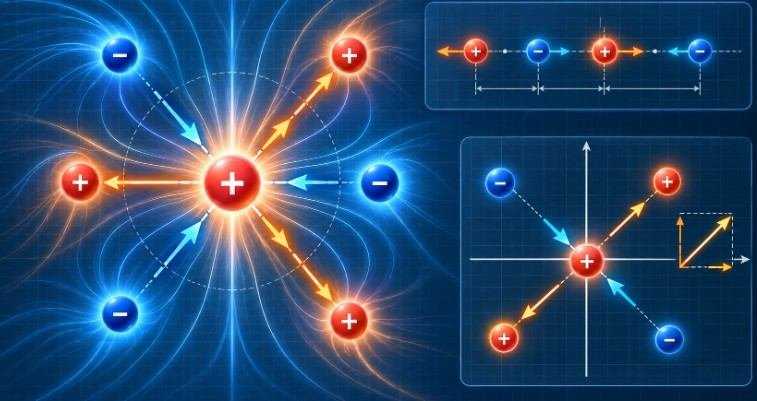
Coulomb’s Law Problems With Multiple Charges: A Vector-First Method
The hardest part of electrostatics is usually not Coulomb’s formula. It is direction. A student can calculate every pairwise force correctly and still miss the final answer by adding magnitudes instead of vectors. The fastest way to solve coulomb’s law problems with multiple charges is to treat each interaction separately, assign a direction immediately, and…
-
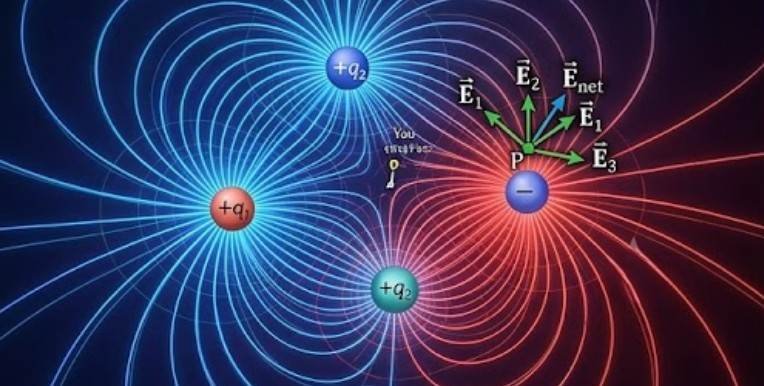
Electric Field Due to Multiple Point Charges: A Practical Vector Method
Two nearby charges can create a point where the net electric field is zero even though neither charge produces zero field there. That is the key idea behind electric field due to multiple point charges: individual fields overlap, and the final result depends on magnitude and direction. The governing rule is superposition. Each source charge…
-

How to Solve Projectile Motion Problems Step by Step Without Mixing Up the Math
A projectile can move forward at a steady rate while accelerating downward at the same time. That single idea explains why a kicked football, a launched water balloon, and a ball rolling off a table can all be solved with the same physics. The trick is not finding one “projectile formula.” It is separating one…
-
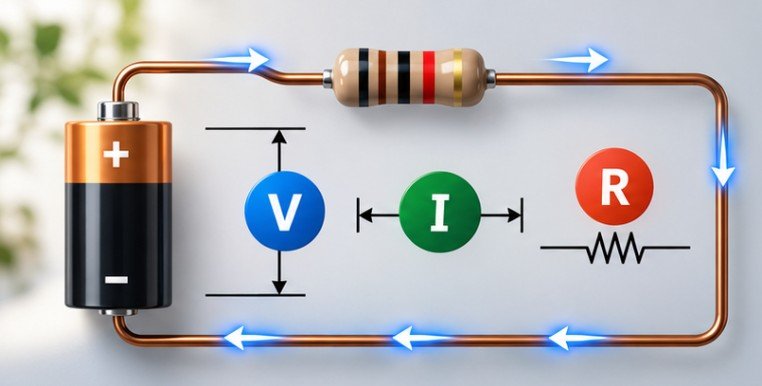
Ohm’s Law Problems With Solutions: A Practical Way to Get Every Answer Right
A one-line equation explains why some circuits draw milliamps while others draw amps: V = IR. The arithmetic is simple; most mistakes come from choosing the wrong form, mixing units, or applying the rule where resistance is not constant. If you are looking for ohm’s law problems with solutions, learn a repeatable method instead of…
-

Conservation of Mechanical Energy Problems: A Practical Solving Metho
A roller coaster can lose height, gain speed, and still keep exactly the same mechanical energy. That fact is what makes conservation of mechanical energy problems so useful: instead of tracking every force through every second of motion, you can often compare only the starting and ending states. For U.S. high school, AP Physics, and…
-
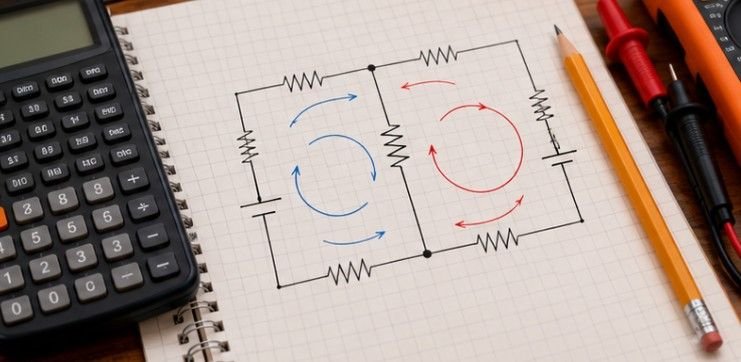
Kirchhoff’s Laws Circuit Problems: A Reliable Way to Solve Multi-Loop Circuits
A negative current is not a failed answer. In many kirchhoff’s laws circuit problems, it simply means your guessed arrow points the wrong way. That idea removes much of the fear from multi-loop analysis: choose directions, write consistent equations, and let the algebra reveal the real flow. Kirchhoff’s rules are conservation laws in circuit form.…
-

How to Solve Inclined Plane Problems With Friction Without Guessing
A useful surprise about a block sliding down a rough ramp is that its mass can disappear from the final acceleration equation. A 2-kg block and a 20-kg block can accelerate identically when they move on the same incline with the same coefficient of kinetic friction. This happens because both the component of gravity pulling…
-

Continuity Equation Fluid Problems: A Practical Way to Solve Them
A pipe can become half as wide and make the fluid move four times faster—not twice as fast. The reason is easy to miss: pipe area depends on the square of its diameter. Once that relationship is clear, continuity equation fluid problems become much easier because the equation is really bookkeeping for one physical rule:…
-

Electric Potential vs Electric Potential Energy: The Difference That Makes the Formulas Click
A point in an electric field can have a potential of 10,000 volts even when no particle is sitting there. Yet that same point has no specific electric potential energy until a charge is introduced. That distinction unlocks electric potential vs electric potential energy. Electric potential describes how much potential energy would exist per unit…
-
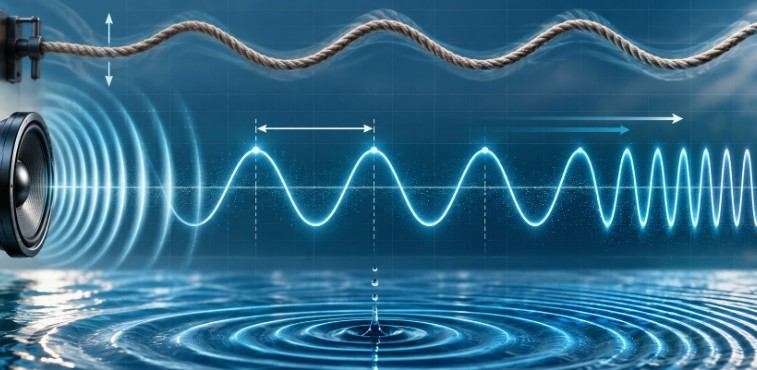
Wave Speed Frequency Wavelength Problems: Solve Them Without Guessing
A wave can cross a classroom, an ocean, or interplanetary space, yet the same compact relationship connects its speed, frequency, and wavelength. That is why wave speed frequency wavelength problems are deceptively simple: the algebra may take one line, but unit errors, graph mistakes, and weak physical reasoning can still produce a wrong answer. The…
Got any book recommendations?